performance
what we measure, and what we will not claim
Technical clothing is where marketing language does the most damage. A word like breathable with no number behind it, or a jacket sold as good to a temperature, sets an expectation the garment cannot keep. This page is the standing statement of what our figures mean, where they came from, and which claims we have decided never to make.
Every product page links here, and every product page states its own gaps in the same words used below.
last updated 12 August 2026
01water repellency, and why we never use the other word
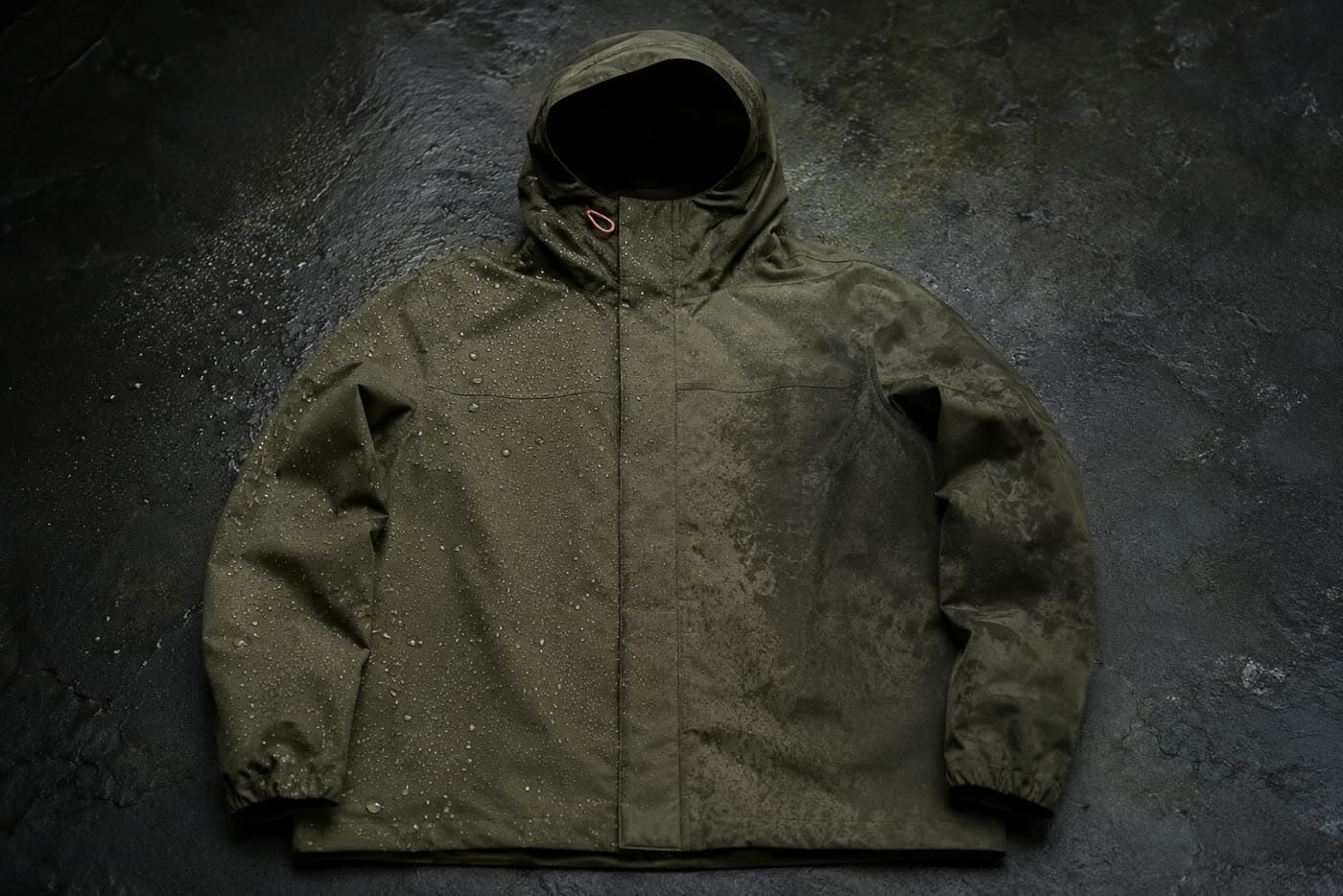
All 24 finished pieces here are described as water-repellent — déperlant. That means a finish on the outside of the fabric makes water bead up and roll off instead of soaking straight in.
The stronger French word imperméable is not used anywhere on this site, and neither is its English equivalent. That word describes a fabric that holds out water under pressure, and proving it requires a hydrostatic test — EN ISO 811, the result given in millimetres of water column. We have not run that test on any of our fabrics, so we publish no such figure and make no such claim. If we ever do run it, the number and the standard will appear together on the product page, or not at all.
- the finish
- PFC-free DWR, C0 chemistry, applied to the face fabric only
- how long it lasts
- roughly 20 to 30 machine washes; 15 to 25 on the 20-denier fabrics, which hold less finish
- where it goes first
- shoulders under a pack strap, and the seat on a saddle
- how you can tell
- water stops beading and rolls into the weave; the face fabric darkens where it soaks in
- how to bring it back
- wash the garment clean, apply a wash-in or spray-on repellent, then reactivate with a warm tumble dry or a warm iron through a cloth
The limit, stated plainly: in rain that does not stop, the face fabric wets out and water reaches the layer underneath — first at the shoulders and the seat. That is true of every shell on this site including the most weather-resistant one, which has taped seams and a coated face and is still described only as water-repellent.
02breathability: no figure, no claim
Breathability is measured as evaporative resistance, RET, under EN ISO 11092. A lower RET means more water vapour gets through. It is a genuinely useful number — and it is only useful with the standard printed beside it, because the alternative test methods give different values for the same fabric.
We have not had our fabrics measured to EN ISO 11092. So every product page shows the RET row with the words not published and an explanation, rather than a figure. You will not find an unqualified breathability superlative anywhere on this site either: with no number behind it, that kind of phrase is decoration.
What we can tell you instead is construction, because construction is observable: whether a garment has pit zips, how long they are, whether the front zip opens two ways, whether the fleece is gridded so it channels air, which panels are densely woven and which are open knit. All of that is on the product pages.
03warmth: fill weight, never a temperature
We publish fabric weight in g/m² and, for insulated pieces, the type of wadding and its fill weight in g/m². We do not publish a temperature figure for any garment, and we never will, because:
- there is no harmonised standard for rating clothing in degrees the way sleeping bags are rated;
- two people walking the same path at different speeds have entirely different results in the same jacket;
- wind, damp and what you have eaten change the answer more than the garment does.
A number that looks precise and is not is worse than no number. The layer planner works the same way: it maps a temperature band to fabric and fill weights, and it never tells you what a combination is rated to.
04wind: construction described, not rated
Where a garment resists wind, we describe how — a dense plain weave at a stated thread count, a full-length flap behind the zip, a collar that closes high, panels placed where a rider meets the air. We do not describe anything as completely stopping wind, because a woven fabric slows moving air rather than sealing it out, and a seam or a zip is a path through.
05sun protection: no UPF number without the test
A UPF value requires a test to EN 13758-1 or an equivalent. One garment in the range — the lightweight sun hoodie — is designed for long exposed days, and it carries no UPF number at all, on the garment or on its page, because that test has not been run. What we describe instead is coverage: a hood cut over a cap brim, long sleeves, thumb loops that keep the back of the hand covered.
06no biocidal treatments, no freshness claims
None of our garments carries a biocidal treatment, and we make no claim about controlling smell. Claims of that kind are regulated in the EU under the Biocidal Products Regulation 528/2012, and they are among the easiest claims in this industry to make loosely. Merino wool behaves well over a long day for reasons to do with how the fibre handles moisture, and that is as far as we will put it.
07reflective trim is not safety equipment
8 pieces in the range carry reflective trim. On each of their pages we list exactly where the trim is, how long each band is, and what it is made of. And on each of those pages there is a notice that cannot be dismissed, saying the same thing this section says:
Reflective trim on our garments is decorative. It is not personal protective equipment, it does not conform to EN ISO 20471 or to any other high-visibility standard, and it has not been tested or certified as safety equipment by anybody. Wearing it does not make a road safe.
We will not say that trim guarantees you are seen, and we will not describe any garment as making night riding safe. Being noticed depends on the driver, the light, the angle, the weather and your position on the road — none of which a strip of tape controls.
08we sell no protective equipment at all
Helmets, body protection and certified high-visibility clothing fall under EU Regulation 2016/425 on personal protective equipment. Selling them means CE marking, a notified body and a declaration of conformity. We have chosen not to be in that category: there is no protective equipment in this range, so nothing here needs that certification and nothing here should be relied on for it.
- No helmets of any kind.
- No impact or abrasion protection.
- No garment claimed to conform to EN ISO 20471 or to any high-visibility class.
- No garment presented as protection against a hazard.
09the one drying time we publish, and its conditions
One garment carries a drying figure: the synthetic quick-dry tee. Here is the whole method, so you can judge it.
- method
- in-house, not a published standard
- procedure
- garment wetted with 100 g of water, hung in still air, weighed repeatedly to constant mass
- conditions
- 20 °C, 50 % relative humidity, no air movement
- result
- 38 minutes
Because the method is ours and not a standard, that figure is only meaningful against our own garments measured the same way. It is not comparable with a drying time printed by another brand under conditions you cannot see.
10how the three grades are decided
Every piece carries a grade for hiking, for cycling and for commuting: suitable, usable or not advised. The grade is a word, always with a reason next to it, and never conveyed by a colour or an icon alone.
- suitable
- designed for it — the cut, the pockets and the fabric all account for that use
- usable
- it will work, and here is precisely what is compromised
- not advised
- we would not choose it for that, and here is why
The cycling grade is the strictest of the three, because a bike changes the geometry of a garment. It depends on back hem length, on sleeve length once your arms are forward on the bars, and on whether there is a rear pocket you can reach from the saddle. Pieces graded suitable for cycling also carry a second measurement table taken on a mannequin at a 35° forward lean.
We do not grade anything as suitable for every activity. Nothing is.
11labels, sizes and the tolerance
- Fibre composition, care instructions and country of make are published for every piece, under EU Regulation 1007/2011. If we could not state all three, the piece would not be listed at all — that rule is enforced in the code, not by hand.
- Sizes are EU sizes with the garment measured flat in centimetres, and a stated tolerance of ±1 cm.
- Where a garment is cut for riding, both tables are published: standing and in a riding position.
- We make no claim about a product being made in any particular country beyond the country of make printed on its page.
See also the size guide and sorting and recycling.