sizing
measured, with the tolerance printed
Every product page carries the garment’s own measurements in centimetres, taken flat, with a tolerance of ±1 cm. We print the tolerance because a run of fabric is never exact, and a number without one implies a precision that does not exist.
how to measure yourself
01chest
Around the fullest part, tape level, arms down, breathing normally.
02waist
Where you actually wear a waistband, not at the narrowest point.
03hip
Around the fullest part, feet together.
04inseam
From the crotch seam of trousers that fit you, down to the hem.
05head
Around the forehead, just above the ears.
06hand
Around the knuckles, excluding the thumb.
our EU sizes, in centimetres
| size | chest | waist | hip | also written |
|---|---|---|---|---|
| EU 46 | 92–96 cm | 78–82 cm | 94–98 cm | S |
| EU 48 | 96–100 cm | 82–86 cm | 98–102 cm | M |
| EU 50 | 100–104 cm | 86–90 cm | 102–106 cm | L |
| EU 52 | 104–110 cm | 90–96 cm | 106–112 cm | XL |
| EU 54 | 110–116 cm | 96–102 cm | 112–118 cm | XXL |
Body measurements, not garment measurements. Garment measurements are on each product page.
between two sizes?
Base layers are drafted close — take the smaller size unless you dislike anything fitted. Mid layers and shells are drafted to go over a base layer at the same size, so take the same number rather than sizing up. If you are between sizes on a shell and intend to wear a heavy mid layer under it, take the larger.
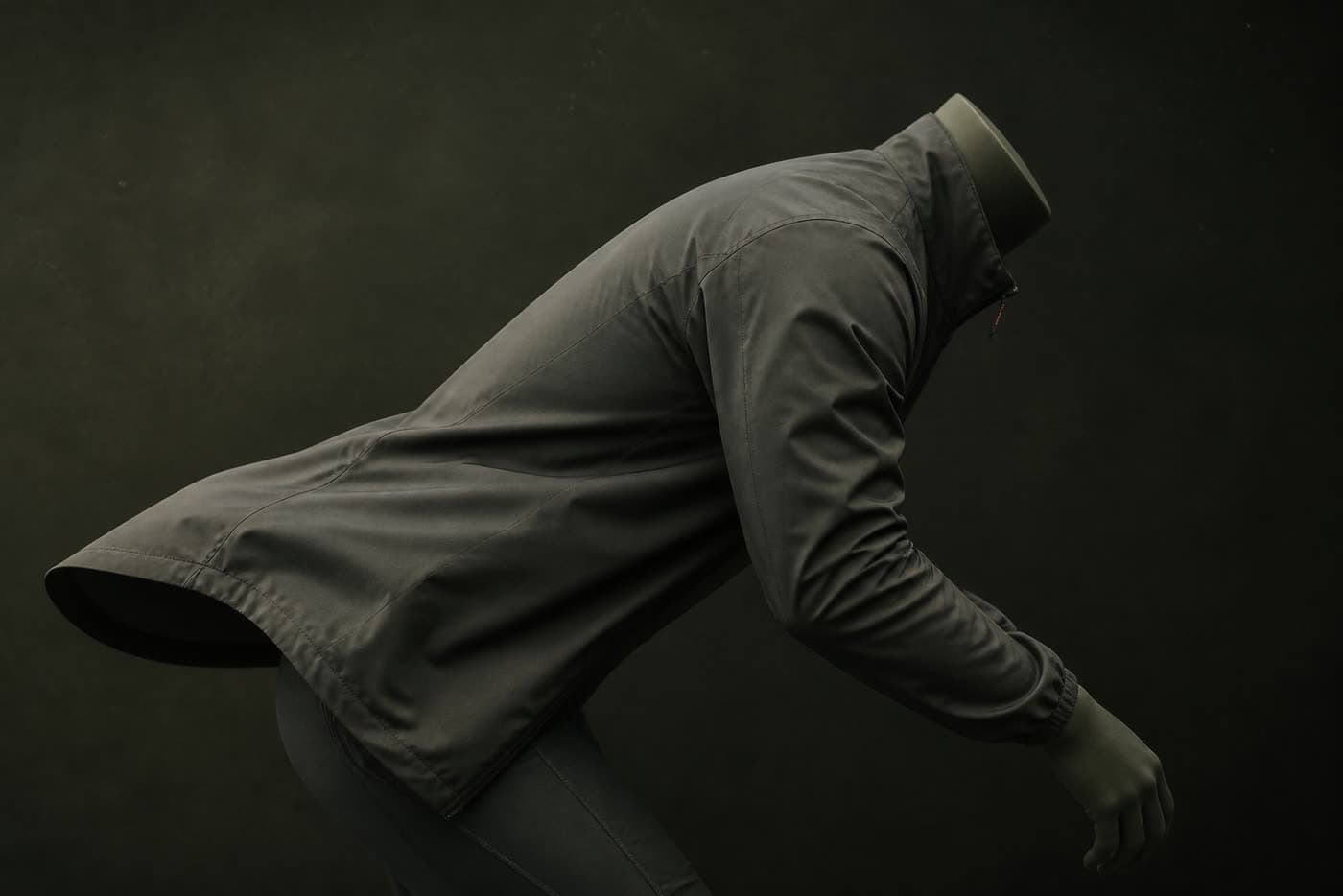
a second table for riding
12 pieces carry a second measurement table taken on a mannequin held at a 35° forward lean. Those figures are lower than the standing ones, because that is what a lean does. We publish both rather than only the flattering one.